


Finished Flyscreen vs Component Supply for Dealers: Which B2B Model Works Better?
Compare finished flyscreen supply and component supply for dealers, installers and distributors. Learn which B2B model fits your production capacity, stock planning and sales strategy.
Finished Flyscreen vs Component Supply for Dealers: Which B2B Model Works Better?
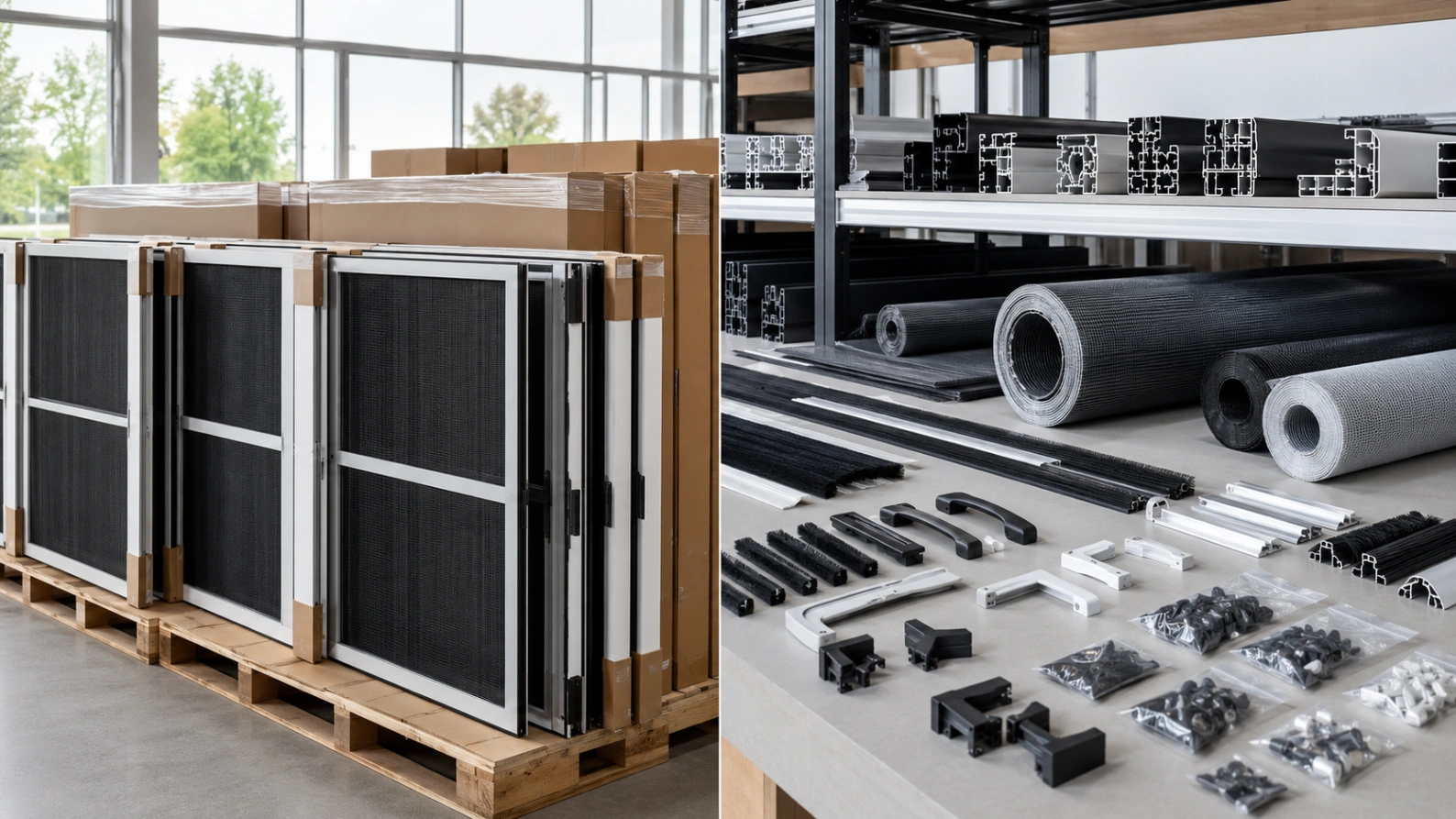
Dealers, installers and distributors can buy flyscreen systems in different supply formats. Some businesses prefer finished flyscreens that are produced, assembled and prepared for installation. Others prefer component supply, such as aluminium profiles, mesh, accessories, brush seals, handle profiles and ready kit parts.
There is no single correct model for every business. The right choice depends on production capacity, technical knowledge, storage space, local labor cost, order volume, delivery expectation and sales strategy. For B2B buyers, understanding the difference between finished flyscreen supply and component supply helps build a more profitable and reliable product range.
What Is Finished Flyscreen Supply?
Finished flyscreen supply means the product is produced and assembled before delivery. The dealer or installer receives a ready-to-install screen prepared according to measurement, product type, color and application detail.
This model is practical for businesses that want to reduce production work, save assembly time and focus on sales, installation and customer service. It can be especially useful for dealers who do not have their own workshop or component stock.
What Is Component Supply?
Component supply means the buyer purchases the parts needed to produce flyscreen systems locally. These parts may include aluminium profiles, pleated mesh, flat mesh, accessories, corner connectors, brush seals, handles, cords, guides and packaging materials.
This model is more suitable for businesses that have their own production area, trained staff and technical capacity. It offers flexibility, but it also requires stronger planning and quality control.
Finished Flyscreen vs Component Supply: Main Difference
| Criteria | Finished Flyscreen Supply | Component Supply |
|---|---|---|
| Production need | Low | High |
| Workshop requirement | Not always required | Required |
| Installation speed | Faster on site | Depends on local production process |
| Stock flexibility | Lower for custom sizes | Higher if components are stocked well |
| Quality control | Mostly handled by supplier | Handled by local producer or dealer |
| Best for | Dealers and installers focused on sales and installation | Manufacturers, distributors and high-volume dealers |
Advantages of Finished Flyscreen Supply
Finished flyscreen supply is useful when the buyer wants a simpler business model. The supplier manages cutting, assembly, component compatibility and production quality before shipping.
- Reduces workshop and labor requirements
- Saves time for dealers and installers
- Supports easier installation planning
- Helps maintain consistent product quality
- Reduces component management complexity
- Useful for businesses without production equipment
This model is especially practical for small and medium dealers, installers, PVC window companies and businesses that prefer not to manage detailed production processes.
Disadvantages of Finished Flyscreen Supply
Finished product supply can be less flexible for businesses that receive many different custom orders at short notice. Since each product must be produced according to measurement, lead time and order planning become important.
Finished products may also require more careful packaging and transport planning because assembled screens can take more space and may need additional protection during delivery.
Advantages of Component Supply
Component supply gives the buyer more control over local production. Businesses that have their own workshop can cut profiles, prepare mesh, assemble products and respond to custom orders more flexibly.
- Higher flexibility for custom measurements
- Better local stock control
- Useful for high-volume production
- Can reduce waiting time if components are stocked
- Supports local assembly and market adaptation
- Suitable for distributors and manufacturers
This model is ideal for buyers with technical experience, trained staff and enough order volume to justify component stock and production planning.
Disadvantages of Component Supply
Component supply requires more responsibility. The buyer must manage cutting accuracy, accessory compatibility, mesh preparation, assembly quality, packaging and final product control.
If production is not standardized, quality may vary between orders. This can create customer complaints, installation problems and higher waste costs. Component supply is powerful, but only when the buyer has the right production discipline.
Which Model Is Better for Dealers?
For dealers, the best model depends on business structure. A dealer focused mainly on sales and installation may prefer finished flyscreens. A dealer with a workshop, trained team and high order volume may benefit more from component supply.
Some dealers use a hybrid model: finished products for complex or low-volume systems, and components for frequently sold standard product groups. This can create a balanced supply strategy.
Which Model Is Better for Installers?
Installers usually need speed, accuracy and fewer complications on site. Finished flyscreen supply can be useful because the product arrives ready for installation.
However, installers with workshop capability may prefer component supply for faster local adjustments. The correct choice depends on whether the installer wants to produce or only install.
Which Model Is Better for Distributors?
Distributors often need repeatable supply, stock planning and product variety. Component supply may be attractive because it allows larger stock volume and flexible local distribution.
However, distributors may also stock ready kits, semi-finished products or selected finished products depending on customer demand. The best distributor model usually combines several supply formats.
Which Products Are Suitable for Finished Supply?
Many flyscreen systems can be supplied as finished products when measurements and project details are clear. This may include pleated flyscreens, hinged flyscreens, fixed flyscreens, sliding flyscreens and selected roll-up systems.
Finished supply is especially useful when product quality, assembly consistency and installation speed are priorities.
Which Products Are Suitable for Component Supply?
Component supply can include aluminium profiles, pleated mesh, flat mesh, brush seals, cords, handle profiles, corner connectors, accessories and packaging materials.
This model is useful for businesses that want to produce locally, manage stock and adapt products to different customer measurements.
Cost Comparison: What Should Buyers Consider?
Finished products may look more expensive per unit, but they reduce local labor, equipment, waste and production management needs. Component supply may look more economical, but it requires labor, workshop space, tools and quality control.
B2B buyers should compare total cost, not only product price. The real cost includes production time, error rate, waste, storage, packaging, installation time and customer service.
Quality Control Differences
In finished flyscreen supply, the supplier controls production quality before delivery. In component supply, the buyer must control product quality during local production.
For this reason, component buyers should create clear production standards. Cutting accuracy, mesh tension, accessory placement, handle alignment, brush seal selection and final testing should be part of the process.
Storage and Logistics Planning
Finished flyscreens require careful storage because assembled products can take more space. Component supply usually allows more compact storage, especially for profiles, mesh rolls and accessories.
However, component storage requires organization. If profiles, accessories and mesh are not managed correctly, production can slow down and errors can increase.
When a Hybrid Model Makes Sense
Many professional buyers use a hybrid model. For example, a dealer may stock components for fast-moving pleated systems while ordering finished products for special sizes, project-based details or systems that require more technical assembly.
A hybrid model can reduce risk and improve flexibility. It allows the buyer to respond to local demand while still benefiting from supplier production support.
Global Search Terms for This Topic
In international markets, this topic may be searched with terms such as finished flyscreen supply, flyscreen component supply, insect screen components, flyscreen profiles wholesale, flyscreen mesh supplier, B2B flyscreen supplier, mosquito screen manufacturer or custom flyscreen production.
In other markets, similar searches may include Fliegengitter Komponenten, Insektenschutz Großhandel, moustiquaire fournisseur professionnel, componenti zanzariera, hor onderdelen groothandel, komarnik komponente or plasa tantari componente.
For B2B Buyers: What Should Be Checked?
- Business model: Decide whether your company wants to produce, install or distribute.
- Workshop capacity: Component supply requires tools, space and trained staff.
- Order volume: High-volume buyers may benefit more from component stock.
- Quality control: Local production requires consistent standards.
- Storage space: Finished products and components require different storage planning.
- Lead time: Finished products require production planning; components require stock planning.
- Supplier support: Technical support, repeat supply and component compatibility should be checked.
Related Sineset Pages
You can review Sineset flyscreen systems and contact the team for finished product, component and B2B supply support.
- Explore Sineset flyscreen systems
- Sineset B2B solutions for professional buyers
- Contact Sineset for flyscreen supply support
Frequently Asked Questions
What is finished flyscreen supply?
Finished flyscreen supply means the screen is produced and assembled before delivery, so the buyer receives a ready-to-install product.
What is flyscreen component supply?
Component supply means the buyer purchases parts such as profiles, mesh, accessories and seals to produce flyscreens locally.
Which model is better for small dealers?
Small dealers often benefit from finished flyscreen supply because it reduces workshop, labor and production management needs.
Which model is better for high-volume buyers?
High-volume buyers with production capacity may benefit from component supply because it offers flexibility and local stock control.
Can dealers use both models?
Yes. Many dealers use a hybrid model by ordering finished products for selected systems and components for frequently sold products.
Final Recommendation
Finished flyscreen supply and component supply both have strong advantages. The right model depends on the buyer’s production capacity, order volume, technical knowledge, storage structure and sales strategy.
Dealers focused on sales and installation may prefer finished flyscreens. Manufacturers, distributors and high-volume buyers may prefer component supply. For many B2B buyers, the most practical solution is a balanced hybrid model that combines both approaches.
